
This disease awareness website has been developed and funded by Pfizer Ltd.
MANAGING MIGRAINE
You are one of many, but your experiences are unique. This page will explore how you can better understand your migraine attacks and ways to help manage your migraine.
Understanding your migraine attacks
One of the steps you can take on your journey to understanding your migraine is to keep a record of your attacks including1,2:
- When your migraines first started
- How your migraines have changed over time
- What migraine triggers you have identified
- What lifestyle changes or medications have helped, and which have not
Documenting the pattern of your migraine attacks, medications and potential triggers can help you better manage your migraines1. In addition, should you visit your doctor about your migraine attacks, your headache diary can help your conversation with your doctor3.
What is a headache diary?
A daily headache diary is one of the important tools for living well with migraine. An accurate headache diary can help to1,2:

Monitor the frequency, duration, and severity of your headaches over time
Identify patterns that may help determine triggers and inform management

Track medication use

Keep a long-term record of what has worked and what has not
Headache diaries can be completed on paper or an electronic device4. No matter which method you choose, it is important to maintain the diary as carefully as possible.
To get started, you can find an interactive migraine diary to help capture each attack, how it affected your daily activities, along with the medication you took (and how well it worked or if you experienced side effects), to aid your discussion with your healthcare professional. The diary can be downloaded (and printed if desired).
Alternatively, you can find a different diary that works for you by searching for “headache diary” online and exploring the different options.
What are migraine triggers?
A trigger is anything that starts or worsens a migraine attack5.
Commonly reported triggers include skipped meals, irregular sleep, and stress6.
Triggers:
- Can be difficult to identify6
- Can vary between an individual's migraine attacks6
- Often combine to start a migraine attack7
A build up of triggers can result in an individual reaching a tipping point (known as the migraine threshold), resulting in the start of a migraine attack5,7.
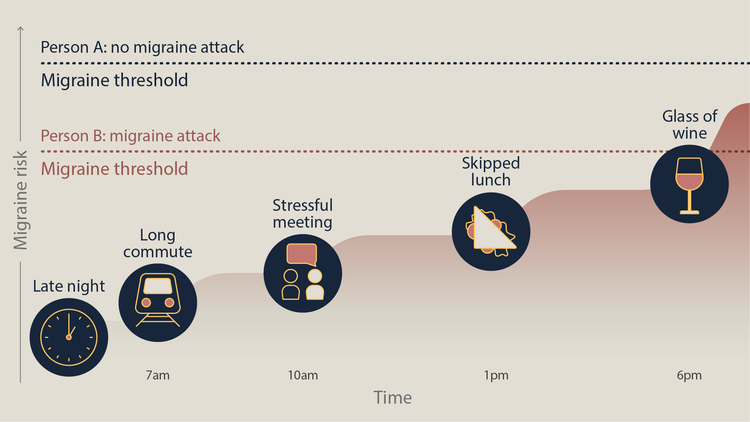
This is a schematic representation only. The graph is not to scale. Adapted from Irish College of General Practitioners7
A glass of wine might not usually trigger a migraine attack for you, but it might if you were to drink a glass on a day when you skipped lunch6.
People with migraine want to identify their triggers to be able to manage them, and there are approaches you can try to help limit the impact of triggers on your migraine attacks6.
8 TIPS FOR MANAGING YOUR MIGRAINE ATTACKS:
Migraine is a medical condition and experiencing attacks is not your fault8.
However, you should feel empowered to make lifestyle changes that may reduce triggers6. This can help reduce the number of migraine attacks you have.
1. Identify triggers1
Keep a log or journal when your migraines occur, so you can identify which triggers seem to impact you the most.

2. Avoid triggers5
Once you know which triggers tend to impact you most, try your best to avoid those which are in your control.

3. Develop a plan9
Have a plan in case a migraine attack starts, for example having a cool, dark, quiet place to lie down

4. Exercise regularly (but not during an attack)6
Exercising frequently helps many people manage their migraines, and it's good for overall health and wellness.

5. Stay hydrated6
A major trigger of migraine attacks is dehydration, so drink at least 8 glasses of water per day and more in hot weather or if you have been exercising.

6. Gradually reduce caffeine intake6
Having too much caffeine can lead to a migraine attack for some people. However, cutting out caffeine suddenly can also trigger migraine attacks. If you think caffeine may be a trigger, it is best to try and gradually cut down the amount you have, rather than stopping suddenly.

7. Eat regular meals6
Skipping meals is a major trigger for many people with migraine. It is important to commit to eating foods that are generally healthy consistently each day.
8. Keep a consistent sleep routine6
Go to bed at the same time each night and wake each morning at about the same time.
References:
1. The Migraine Trust. Keeping a headache diary. https://migrainetrust.org/live-with-migraine/self-management/keeping-a-migraine-diary/. [Last accessed November 2025].
2. National Institute for Health and Care Excellence. Clinical guideline [CG150]. Headaches in over 12s: diagnosis and management. Published: 19 September 2012. Last updated: 17 December 2021. https://www.nice.org.uk/guidance/cg150/chapter/recommendations. [Last accessed November 2025].
3. Nappi G., et al. Diaries and calendars for migraine. A review. Cephalgia. 2006;26(8):905–16. https://doi.org/10.1111/j.1468-2982.2006.01155.x [Last accessed November 2025].
4. National Migraine Centre. Headache Diary. https://www.nationalmigrainecentre.org.uk/headache-diary/. [Last accessed November 2025].
5. National Migraine Centre. Migraine triggers. A National Migraine Centre factsheet. https://www.nationalmigrainecentre.org.uk/understanding-migraine/factsheets-and-resources/migraine-triggers/. [Last accessed November 2025].
6. The Migraine Trust. Migraine attack triggers. https://migrainetrust.org/live-with-migraine/self-management/common-triggers/. [Last accessed November 2025].
7. Irish College of General Practitioners. Migraine: Diagnosis and Management from a GP Perspective: Quick Reference Guide. 2019. [Last accessed November 2025].
8. Rizzoli P. Preventive Pharmacotherapy in Migraine. Headache. 2014;54(2):364–9. https://doi.org/10.1111/head.12273 [Last accessed November 2025].
9. NHS 111 Wales. Migraine. https://111.wales.nhs.uk/encyclopaedia/m/article/migraine. [Last accessed November 2025].
Links to external websites are provided as a resource to the viewer.
The linked websites are neither owned nor controlled by Pfizer Ltd. Pfizer accepts no responsibility for the content or services of the linked site/s.
The information provided on this site is intended for general information and education and is not intended to be a substitute for advice provided by a doctor or other qualified healthcare professional.
PP-UNP-GBR-13535. November 2025.